
- October 13, 2026
- by Parbeshkumar Maurya
RFM Segmentation for Email Marketing: A Step-by-Step Guide with Examples
Not every customer on your email list has the same relationship with your brand. Some purchased yesterday, some buy every month, and others haven’t returned in six months. Yet many businesses continue sending the same promotional campaigns to all three.
The result? Loyal customers receive unnecessary discounts, first-time buyers miss valuable follow-ups, and inactive customers receive offers that don’t address why they stopped purchasing.
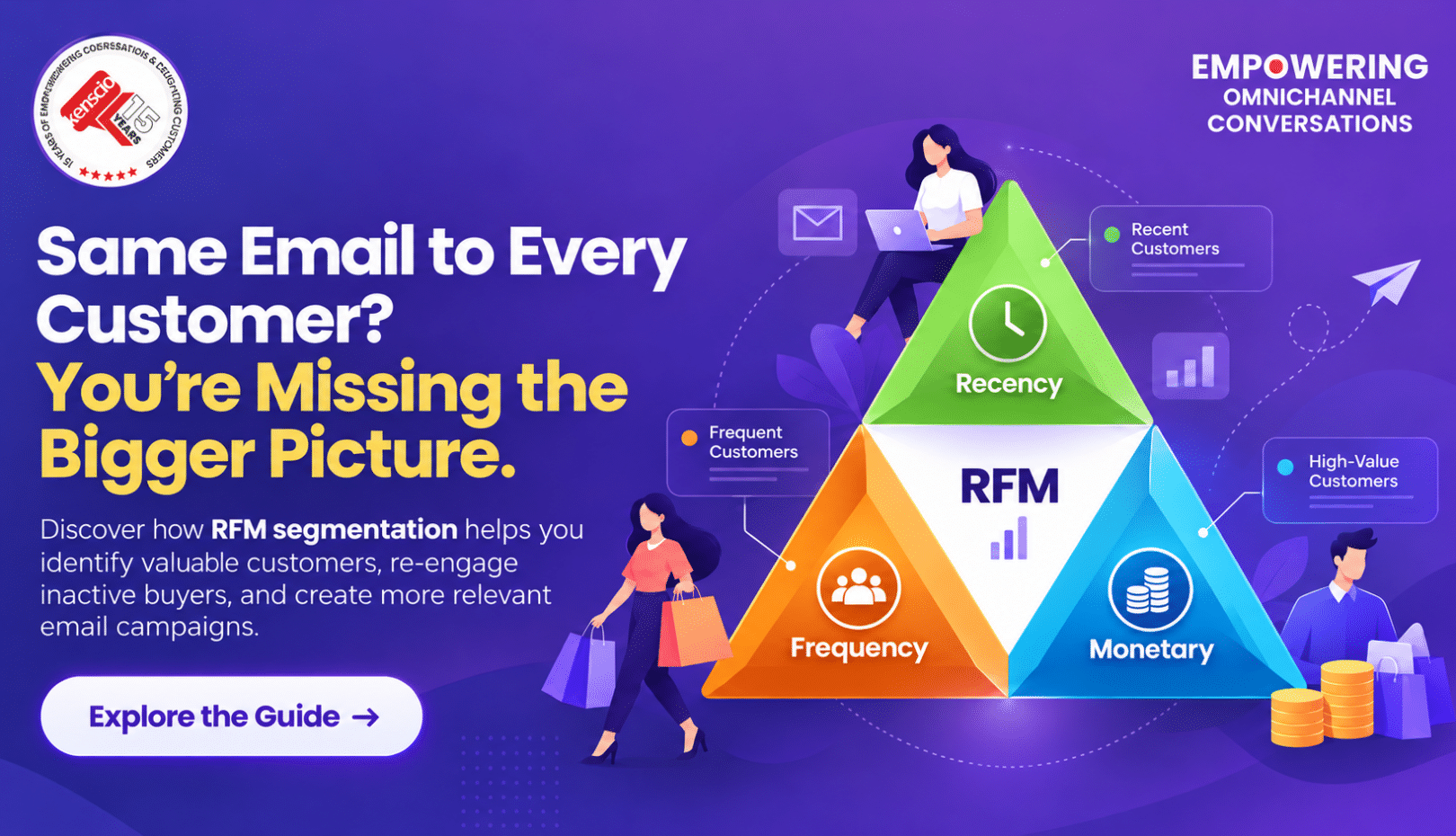
RFM segmentation offers a practical way to solve this problem. By analyzing how recently customers purchased, how often they buy, and how much they spend, marketers can group customers based on actual purchase behavior and create more relevant email campaigns.
With basic transaction data and a simple scoring system, businesses can turn customer purchase history into an actionable email marketing strategy.
Quick Snapshot
RFM stands for Recency, Frequency, and Monetary value. It is a customer segmentation method that uses purchase history to identify loyal customers, recent buyers, high spenders, customers at risk of becoming inactive, and those who may need re-engagement.
Instead of sending everyone the same message, businesses can use RFM scores to tailor email content, offers, and customer journeys to different buying patterns.
The goal isn’t just to segment customers. It’s to know what to do with each segment.
In This Guide, We'll Explore
- What Is RFM Segmentation in Email Marketing?
- Why RFM Segmentation Matters for Email Marketing
- How to Do RFM Segmentation: Step by Step
- Example: Two Customers, Two Different Emails
- How to Automate RFM-Based Email Campaigns
- How to Measure RFM Email Campaign Performance
- Common RFM Segmentation Mistakes to Avoid
What Is RFM Segmentation in Email Marketing?
RFM segmentation is a data-driven method of grouping customers according to three purchasing behaviors:
| RFM Factor | What It Measures | Why It Matters |
| Recency (R) | How recently a customer made a purchase | Helps identify active and inactive buyers |
| Frequency (F) | How often a customer purchases | Helps distinguish repeat buyers from occasional customers |
| Monetary (M) | How much a customer spends | Helps identify customers contributing greater revenue |
For example, a customer who purchased three days ago, has placed 12 orders, and spent ₹30,000 represents a different engagement opportunity from someone who purchased once eight months ago for ₹800.
RFM analysis makes these differences measurable, allowing marketers to build email campaigns around customer purchase behavior rather than relying on demographic information alone.
Why RFM Segmentation Matters for Email Marketing
Traditional email segmentation often relies on attributes such as age, location, gender, or signup source. While useful, these details don’t necessarily reveal how customers actually purchase.
RFM adds transactional context, helping businesses recognize valuable customers, identify declining purchase activity, and prioritize retention opportunities.
For example, a loyal customer may appreciate early access to a new collection, while a first-time buyer may benefit from product education. A previously valuable customer who hasn’t purchased recently may need a more thoughtful re-engagement approach.
This makes RFM particularly useful for ecommerce, retail, D2C brands, and businesses with repeat purchase activity.
How to Do RFM Segmentation: Step by Step
Let’s walk through a simple example using a fictional ecommerce brand.
Step 1: Collect Customer Purchase Data
Start with transaction data from your ecommerce platform, CRM, or customer database. You need a customer identifier, purchase dates, order counts, and purchase amounts.
For this example, assume we’re analyzing purchases as of October 1, 2026, using the previous 12 months of completed orders.
| Customer | Days Since Last Purchase | Orders | Total Spend |
| Asha | 5 | 12 | ₹30,000 |
| Rahul | 15 | 2 | ₹3,000 |
| Priya | 45 | 8 | ₹20,000 |
| Karan | 120 | 4 | ₹8,000 |
| Neha | 240 | 10 | ₹25,000 |
| Arjun | 300 | 1 | ₹800 |
Illustrative data created for this example, not actual customer results.
Recency represents the number of days since the most recent purchase, frequency represents completed orders, and monetary value represents total spending during the analysis period.
For accurate results, businesses should consistently handle cancellations, refunds, duplicate orders, and the reporting period.
Step 2: Assign RFM Scores
Next, convert the raw numbers into scores. A common approach uses a 1–5 scale, where 5 represents the strongest value for each dimension.
The scoring direction is important:
- Recency: Fewer days since purchase receive a higher score.
- Frequency: More purchases receive a higher score.
- Monetary: Higher spending receives a higher score.
For this example, we’ll use the following scoring rules.
| Score | Recency | Frequency | Monetary |
| 5 | 0–30 days | 10+ orders | ₹25,000+ |
| 4 | 31–60 days | 7–9 orders | ₹15,000–₹24,999 |
| 3 | 61–120 days | 4–6 orders | ₹7,000–₹14,999 |
| 2 | 121–240 days | 2–3 orders | ₹2,000–₹6,999 |
| 1 | More than 240 days | 1 order | Below ₹2,000 |
These thresholds are illustrative, not universal benchmarks. Businesses should establish scoring boundaries based on their purchase cycles, customer distribution, and average order values. Larger datasets often use percentile-based scoring to divide customers into relative groups.
Step 3: Calculate Each Customer’s RFM Score
Now apply the scoring rules to the sample dataset.
| Customer | R Score | F Score | M Score | RFM Code |
| Asha | 5 | 5 | 5 | 555 |
| Rahul | 5 | 2 | 2 | 522 |
| Priya | 4 | 4 | 4 | 444 |
| Karan | 3 | 3 | 3 | 333 |
| Neha | 2 | 5 | 5 | 255 |
| Arjun | 1 | 1 | 1 | 111 |
An RFM code combines the three scores in the order Recency–Frequency–Monetary.
For example, Asha (555) purchased recently, buys frequently, and spends heavily. Neha (255) has a strong purchase history but hasn’t purchased recently.
These customers may both be commercially valuable, but their current engagement needs are different.
You can also calculate a total RFM score by adding the three values. However, keeping the three-digit code is often more informative because customers with the same total score can have different purchasing patterns.
Step 4: Create Actionable Customer Segments
Once customers have RFM scores, the next step is to group them into meaningful segments.
Rather than creating a separate campaign for every possible score combination, start with a manageable number of groups that support clear marketing objectives.
| Customer Segment | Example RFM Pattern | What It Means |
| Champions | 555 | Most recent, frequent, and high-spending customers |
| Loyal Customers | 444 | Consistent repeat buyers with strong purchase activity |
| Recent Customers | 522 | Recently active customers with relatively limited purchase history |
| Developing Customers | 333 | Moderately active customers with opportunities for repeat purchases |
| At-Risk High-Value Customers | 255 | Historically valuable customers showing declining purchase recency |
| Hibernating Customers | 111 | Long-inactive customers with limited purchase history |
These labels are illustrative. In a real RFM model, each segment typically includes a range of scores rather than a single combination.
The most important step is to define clear, mutually exclusive rules so customers don’t unintentionally enter multiple conflicting segments.
These labels are illustrative. In a real RFM model, each segment typically includes a range of scores rather than a single combination.
The most important step is to define clear, mutually exclusive rules so customers don’t unintentionally enter multiple conflicting segments.
Step 5: Build Email Campaigns for Each RFM Segment
RFM scores become useful when they inform what customers receive next.
A customer who regularly purchases from your brand doesn’t necessarily need another discount. Similarly, a customer who hasn’t purchased in months may not respond to the same promotional message as someone who bought yesterday.
Here’s how each segment can translate into an email marketing strategy:
| Segment | Email Strategy | Example Subject Line |
| Champions | VIP rewards, exclusive previews, early product access | Your VIP Early Access Starts Today |
| Loyal Customers | Relevant recommendations, loyalty benefits, new arrivals | New Arrivals Inspired by Your Past Purchases |
| Recent Customers | Post-purchase education, product tips, second-purchase nurturing | 3 Tips to Get More from Your Recent Purchase |
| Developing Customers | Complementary products, cross-sell, personalized discovery | Discover More of What You Love |
| At-Risk High-Value Customers | Win-back campaigns, relevant updates, feedback requests | See What’s New Since Your Last Visit |
| Hibernating Customers | Limited reactivation, preference confirmation | Would You Still Like to Hear from Us? |
These campaigns should reflect actual customer behavior, product relevance, and communication preferences. For instance, a brand should only promise VIP access or personalized recommendations when those benefits genuinely exist.
Example: Two Customers, Two Different Emails
Consider Asha and Neha from our sample dataset.
Asha (555): Reward Loyalty
Asha is an active, high-value customer. Instead of automatically offering another discount, the brand could recognize her loyalty with early access to a new collection.
Example email:
Subject: Your VIP Early Access Starts Today
Message: As one of our valued customers, you’re getting an early look at our newest collection before the public launch. Explore what’s new and discover your favourites.
CTA: Explore the Collection
Neha (255): Rebuild Engagement
Neha has historically purchased frequently and spent heavily but hasn’t returned in 240 days. Her email should focus on renewed relevance rather than assuming she simply needs a larger discount.
Example email:
Subject: See What’s New Since Your Last Visit
Message: It’s been a while since your last purchase, and we’ve introduced some exciting new arrivals. Take a look at what’s changed and discover products that might interest you.
CTA: Explore What’s New
Both customers have a history of spending with the brand, but their recent purchase behavior calls for different approaches.
This is the practical value of RFM segmentation: using customer behavior to guide communication instead of treating every customer the same.
How to Automate RFM-Based Email Campaigns
How to Measure RFM Email Campaign Performance
Creating customer segments is only the beginning. Marketers also need to understand whether their campaigns improve customer behavior.
Metric | What It Helps Measure |
Repeat Purchase Rate | Whether customers return to buy again |
Revenue per Recipient | Revenue generated relative to the targeted audience |
Segment Migration | Whether customers move into stronger RFM groups |
Reactivation Rate | Whether inactive customers return |
Average Order Value | Whether purchase value changes |
Customer Retention Rate | Whether customers remain active over time |
Unsubscribe and Complaint Rates | Whether communication remains relevant and welcome |
For example, the success of an at-risk customer campaign shouldn’t be judged only by opens or clicks. The more meaningful question is whether those customers returned, purchased again, or showed renewed engagement.
Where possible, compare results with an appropriate control group to determine whether the campaign contributed to the improvement.
Common RFM Segmentation Mistakes to Avoid
RFM is straightforward to implement, but several mistakes can reduce its effectiveness.
Using the same scoring thresholds for every business: A 90-day purchase gap may indicate inactivity for a grocery brand but be normal for a furniture retailer. Scoring must reflect the purchase cycle.
Treating RFM as a complete customer profile: RFM describes purchase history, not customer motivations, product preferences, consent status, or future intent. Combine it with other relevant signals where available.
Creating too many segments: A highly detailed scoring model can become difficult to manage. Start with a few actionable groups and expand only when there is a clear marketing purpose.
Relying on outdated scores: Customer behavior changes. Refresh segments regularly so campaigns reflect recent purchases and inactivity.
Sending discounts to every segment: Loyal customers may value recognition, convenience, or early access more than price reductions. Match the incentive to the customer’s relationship with the brand.
Ignoring email engagement and consent: A high RFM score doesn’t automatically mean someone wants frequent emails. Respect communication preferences, suppression rules, and signs of disengagement.
RFM is most effective when it supports ongoing marketing decisions rather than becoming another static label in the CRM.
How We Helps Businesses Turn Customer Data into Relevant Engagement
Final Thoughts
RFM segmentation helps businesses answer three simple questions: When did the customer last buy? How often do they buy? How much do they spend?
Together, these answers reveal meaningful differences between customers who may otherwise look identical in an email database.
By collecting transaction data, assigning scores, creating actionable segments, and tailoring email journeys, marketers can improve communication relevance without starting with a complex analytics system.
Ultimately, the value of RFM isn’t the score itself. It’s using that score to make better decisions about who to engage, what to communicate, and when to act.
Source
https://datainnovation.io/en/the-rfm-segmentation-email-marketing-playbook-that-actually-works/
https://www.optimove.com/resources/learning-center/rfm-segmentation
https://www.braze.com/resources/articles/rfm-segmentation
https://www.crmcarecloud.com/blog/tutorials/a-step-by-step-guide-use-rfm-segmentation-in-your-campaigns/
https://mailchimp.com/resources/rfm-analysis/
