
- September 4, 2026
- by Parbeshkumar Maurya
The Science of Email Timing: When to Send Emails for Maximum Engagement and Conversions
You may create the perfect email campaign with a strong subject line, polished design, relevant offer, and clear call-to-action—but still see disappointing results.
Often, the issue isn’t the content. It’s the timing.
In crowded inboxes, even your best campaign can be missed if it reaches subscribers when they’re busy, distracted, or not actively checking email. That’s why send time plays a direct role in open rates, click-through rates, and conversions.
There is no universal “best time” to send emails. The right timing depends on your audience, industry, customer behavior, time zone, and campaign type.
According to industry studies, nearly 21% of email campaigns are opened within the first hour of delivery, highlighting how send time can significantly influence campaign visibility and engagement.
In this guide, we’ll explore why email timing matters, industry-specific send time benchmarks, and how businesses can optimize delivery using data, segmentation, and AI-powered insights.
Quick Snapshot
Email timing plays a critical role in campaign success. While there is no one-size-fits-all send time, businesses that analyze customer behavior, segment audiences, and optimize delivery based on engagement patterns consistently achieve higher open rates, better click-through rates, and stronger conversions.
In This Guide, We'll Explore
Why-Email-Timing-Matters
Creating a great email is only half the equation. Even the most compelling campaign can underperform if subscribers don’t see it at the right time. Timing directly influences whether your message is opened immediately, ignored, or buried beneath newer emails.
Email timing directly influences:
- Open rates
- Click-through rates
- Conversions
- Customer engagement
- Unsubscribe rates
A campaign sent when subscribers are actively checking their inbox has a far greater chance of generating engagement than one buried beneath dozens of newer emails.
The objective isn’t simply to send emails earlier or later—it’s to deliver them when customers are most likely to notice, open, and take action.
Is There Really a "Best Time" to Send Emails?
One of the most common questions marketers ask is: “What is the best day and time to send marketing emails?”
The honest answer is there isn’t a single best time for every business.
While many industry studies suggest Tuesday, Wednesday, and Thursday mornings often perform well, these should only be considered starting benchmarks—not universal rules.
The ideal send time depends on several factors, including:
- Your industry
- Audience demographics
- Geographic location and time zones
- Customer behavior
- Purchase patterns
- Type of email campaign
For example, a B2B software company may achieve higher engagement during weekday business hours, while an ecommerce retailer may see better results during evenings or weekends when customers are more likely to shop online.
The most successful marketers don’t rely solely on industry averages—they continuously analyze customer engagement and optimize send times based on their own audience data.
Recommended Email Send Times by Industry
While there is no universal “best time,” industry benchmarks can provide a useful starting point before optimizing based on customer behavior.
| Industry | Best Days | Recommended Time | Why It Works |
| B2B / SaaS | Tuesday–Thursday | 9:00 AM–11:00 AM | Professionals are most active during business hours. |
| Ecommerce & Retail | Thursday–Sunday | 6:00 PM–9:00 PM | Customers typically browse and shop after work or on weekends. |
| Banking & Financial Services | Tuesday–Thursday | 8:00 AM–10:00 AM | Financial communications receive better attention during the workweek. |
| Healthcare | Monday–Friday | 8:00 AM–10:00 AM | Appointment reminders and healthcare communications are commonly reviewed early in the day. |
| Travel & Hospitality | Wednesday–Friday | 12:00 PM–3:00 PM | Many travelers research trips during lunch breaks or before weekends. |
| Education & EdTech | Tuesday–Thursday | 10:00 AM–2:00 PM | Students and professionals often engage during study or work breaks. |
| Media & Entertainment | Thursday–Sunday | 5:00 PM–9:00 PM | Users actively look for entertainment during evenings and weekends. |
| Real Estate | Thursday–Saturday | 4:00 PM–7:00 PM | Property research often happens after work and over the weekend. |
Pro Tip: If your audience spans multiple regions, schedule emails based on each subscriber’s local time rather than sending every campaign simultaneously. Localized delivery often improves engagement and customer experience.
Factors That Influence Email Timing
- Customer Behavior: Past engagement data provides valuable insights into when subscribers typically open emails, browse websites, or complete purchases. Historical behavior is often the strongest indicator of future engagement.
- Time Zones: For businesses with national or global audiences, sending emails according to each recipient’s local time significantly improves visibility and engagement.
- Industry and Audience: Different audiences have different routines. B2B professionals, retail shoppers, healthcare patients, and travelers all engage with email at different times. Understanding your audience is far more valuable than following generic benchmarks.
Campaign Type
The objective of the campaign should also determine when it’s sent.
For example:
- Welcome emails should be delivered immediately.
- Transactional emails should be sent instantly.
- Promotional emails often perform better during shopping periods.
- Event reminders should be sent closer to the event date and time.
Best Practices for Optimizing Email Send Times
There is no single formula for finding the perfect send time. Successful marketers continuously test, analyze, and refine their email schedules using customer engagement data rather than relying on fixed assumptions.
- Analyze Historical Campaign Performance: Review open rates, click-through rates, and conversions to identify when subscribers are most engaged.
- Segment Your Audience: Different customer segments often respond differently based on geography, lifecycle stage, industry, and engagement history.
- A/B Test Send Times: Experiment with different days and times to identify the optimal schedule for your audience.
- Match Timing to Customer Intent: Behavior-triggered emails such as welcome messages, cart abandonment reminders, and purchase confirmations should always be sent immediately.
- Optimize Continuously: Customer behavior changes over time. Regular testing and performance analysis help ensure your email timing evolves alongside your audience.
Common Mistakes Businesses Make
Many organizations unintentionally reduce campaign performance by:
- Sending every campaign at the same time
- Ignoring customer time zones
- Following industry benchmarks without testing
- Overlooking subscriber behavior
- Sending too frequently
- Failing to review campaign analytics
Successful email timing is based on customer behavior—not assumptions.
How AI Is Transforming Email Timing
Artificial Intelligence is changing how marketers determine the best time to send emails.
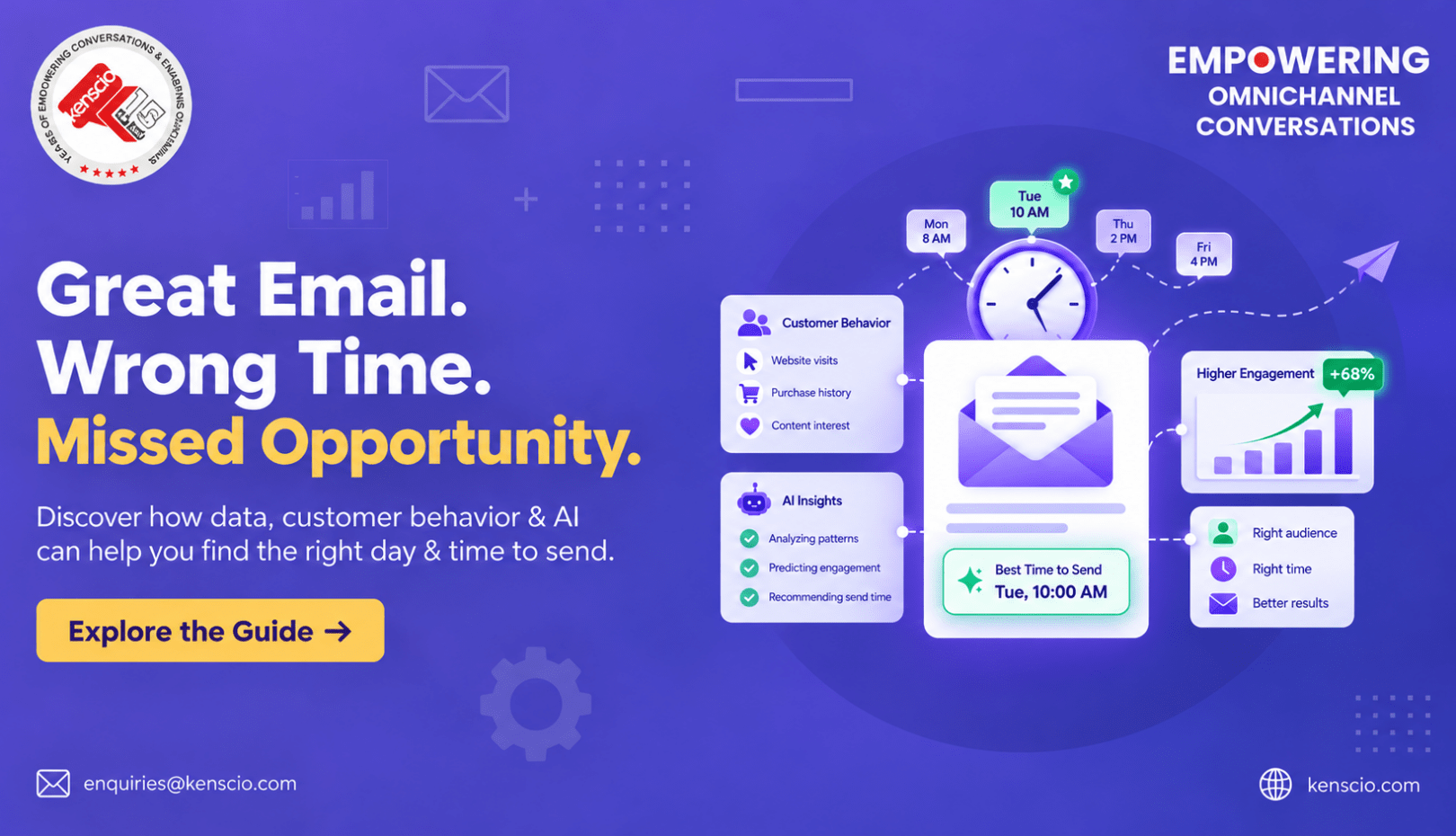
Instead of delivering campaigns to an entire audience simultaneously, AI analyzes individual engagement patterns—including email opens, click behavior, purchase history, preferred devices, and historical activity—to identify when each subscriber is most likely to engage.
This approach, often called Send Time Optimization (STO), enables businesses to improve engagement by delivering emails at the optimal moment for every individual rather than relying on a single schedule for all recipients.
As AI continues to evolve, send time optimization is becoming a standard capability for businesses looking to maximize campaign performance at scale.
Example: Timing Makes the Difference
Imagine an ecommerce retailer launching a weekend sale.
Rather than sending the promotional email to every subscriber at 9:00 AM on Friday, the marketing team analyzes customer engagement patterns. Subscribers who usually open emails in the evening receive the campaign after work, weekend shoppers receive it on Saturday morning, and highly engaged weekday users receive it during their preferred browsing hours.
Although the email content remains identical, delivering it when each customer is most likely to engage significantly improves visibility, increases opens, and creates more opportunities for conversions.
This demonstrates that successful email marketing isn’t only about crafting compelling content—it’s also about delivering it at the right moment.
Final Thoughts
There is no universal “best time” to send emails. The most effective send time depends on your audience, campaign objectives, customer behavior, and engagement history.
Businesses that move beyond fixed schedules and adopt data-driven, behavior-based send time optimization consistently achieve higher engagement, better conversions, and stronger customer relationships.
Email timing is no longer about choosing Tuesday morning because an industry report recommends it. It’s about understanding your audience, analyzing engagement patterns, and continuously optimizing delivery based on real customer behavior. Businesses that combine customer insights, automation, and AI-powered send time optimization consistently achieve stronger engagement, better customer experiences, and higher marketing ROI.
How Kenscio Helps Businesses
